
Epic Precision · proprietary window film cutting & kitting process · McKinney, TX and Aurora, CO
No film Epic installs has ever been trimmed to your glass by hand. Since 2023, a machine we built cuts every piece.
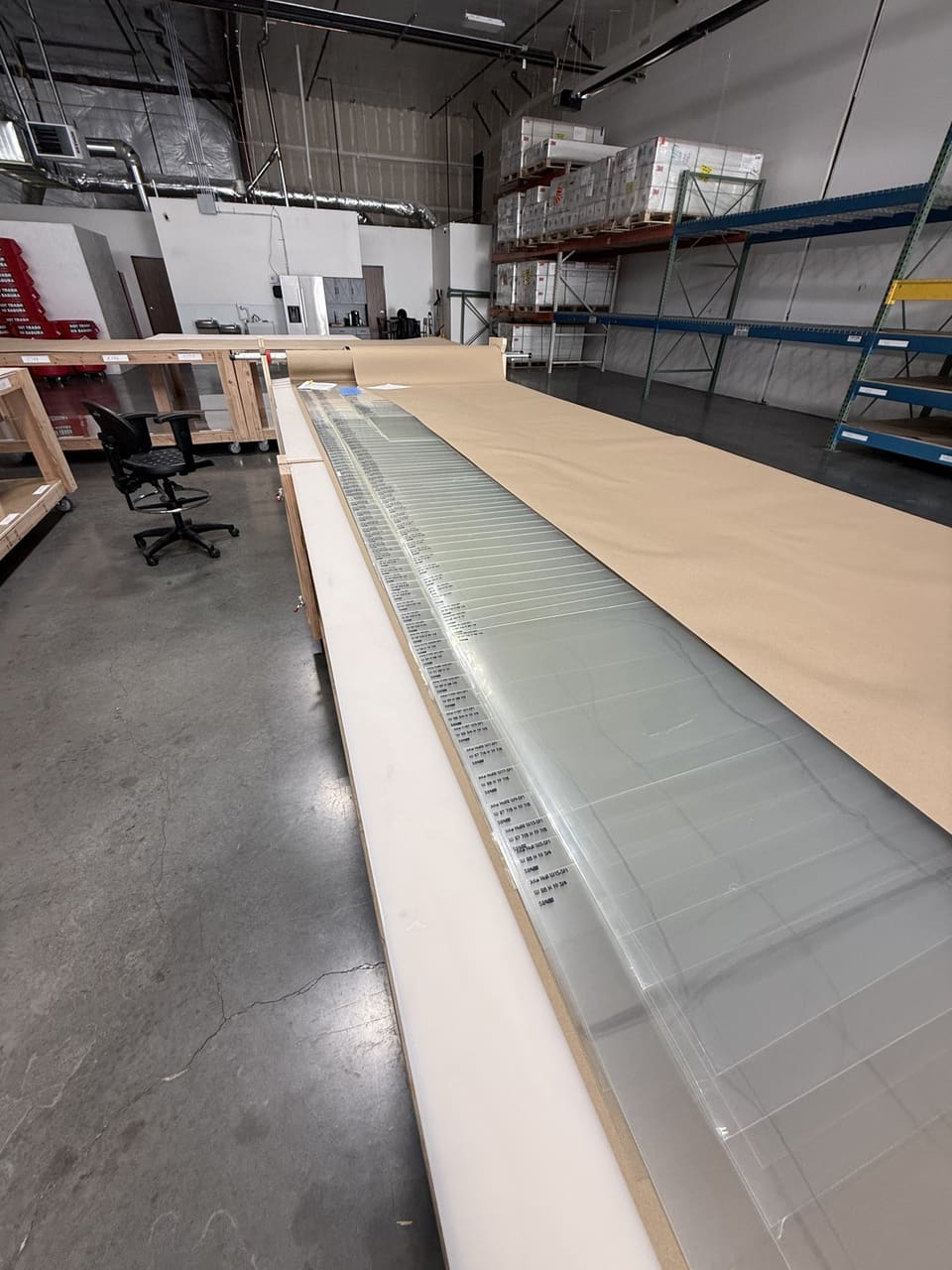
Every opening on your building is measured and nested across the roll in PaneCast — Epic’s proprietary estimating software — cut by machine, labeled with its door or window and kitted in installation order. The crew walks in with finished pieces. Epic spent more than half a million dollars developing the machine and the software that make it possible. It is not something you can order.
- Measured at survey, opening by opening
- Nested by Epic’s own software — less waste, lower cost
- Machine-cut, labeled, kitted in install order
- No cutting station on your site
Most of the industry still measures and trims film in the corridor. Epic never has.
Watch almost any security film installation and you will see it: a roll on a handler, a tape measure, a blade, a piece trimmed to the glass by hand while the room waits. It is how most of the industry has always worked. It is not how Epic has ever worked. From the first job, every opening was measured at the survey, the film was cut to pattern in our shop on a manual cutting machine, each piece was labeled for its door or window, and the crew carried finished pieces onto the site. That is the process in the film 3M shot at our Texas school installation in 2023 — a step ahead of the industry already.
That same year we retired the manual machine and built Epic Precision, and every job since has run through it. Epic invested more than half a million dollars developing a machine and the software behind it — a system that takes every opening from the survey, nests the patterns across the roll, precision-cuts each piece and labels it for the door it belongs to. It runs in our McKinney cutting department and, in its newest and most capable form, in our Colorado office. None of it came off a shelf, and none of it is for sale. Three-plus years and thousands of openings later, it is simply how Epic works. The front of the system is PaneCast, Epic’s own estimating software — the tool the Field Project Manager measures with on your building. The survey becomes the estimate, the estimate becomes the nest, the nest becomes the cut, and the cut becomes the kit; one record travels from the first measurement to the installed window. Epic has become a technology company within the window film industry.
Here is why it matters more on a security film than on anything else we install. When a person cuts film by hand — or pulls it through one of the hybrid roll handlers most of the industry uses and trims it — the edge gets nicked. Most installers bury the nick under the sealant and call it fine. From inside the room it is hidden. From outside, it is still there if you know where to look. And that nick is the tear point: when the glass breaks, the film rips open from it like a sheet of paper. The machine removes the human error.
“This is what makes us Epic. We never stop looking for a better process, because a better process is a better outcome — a cleaner installation for the building today, and a film that does its job on the day it is needed.”Chris Eder, Chief Visionary Officer
Six steps between your glass and a finished piece.
The same six on a 20-window office and a 50,000-window district.
Survey: every opening measured, straight into the software
A Field Project Manager measures each piece of glass on the project — not a sample, every one — in PaneCast, Epic’s own estimating software, with frame type, gasket condition and hardware. There is no notebook and no re-keying: the measurement that produces your price is the same measurement that produces the pattern, under its own door or window number.
Nesting: the roll laid out like a suit
PaneCast nests every pattern across the roll of 3M film the way a tailor lays out a suit, fitting the most panes it can into the material on hand. Done by hand off a roll, with a tape and arithmetic, the waste is whatever is left over; done this way, the waste is designed out before a roll is opened. Less film bought is a real number on your invoice, not a slogan.
Cut: by the Epic Precision machine, to the pattern
The Epic Precision machine cuts the nest. No blade in a hand, no roll handler pulled by hand — the two ways a security film gets nicked before it ever reaches the glass. Every edge is a clean, exact cut to the opening, with no tear point waiting in it.
Label and kit, in install order
Each piece is labeled with its door or window and kitted by campus, floor and room, in the order the crew will walk the building.
Install: finished pieces, no downtime
The crew arrives with finished pieces. No rolls in the corridor, no cutting station in a classroom, no one measuring and trimming while the room waits. The work moves room to room and the building stays in use.
Record: what went where
The pattern list becomes the closeout record — opening by opening — and the basis of the 3M warranty registration Epic files within 30 days.
Why a precision-cut job costs the customer less, not more.
People assume the machine, the software and the kits are an expense that shows up in the price. It is the other way around. The process takes cost out of a job in three places, and each one is money the customer would otherwise be paying for.
Less film bought
Film is sold by the roll and cut to the window; everything between the pieces is paid for and thrown away. PaneCast fits the maximum number of panes into the material available, across every opening on the job at once — a layout no one can work out by hand off a roll with a tape measure and arithmetic. The project buys fewer rolls, and the difference is in your number.
Fewer hours on your site
On most jobs the clock runs while someone measures, unrolls, trims and re-trims in the corridor. Epic’s crews arrive with every piece already cut, labeled and sequenced, so the hours on site are installation hours. A faster install is a cheaper install, and a building — or a school day — that is barely interrupted is worth something that never appears on an invoice.
Measured once, right
The measurement taken on your glass is the one the estimate is built on, the one the pattern is cut from and the one that goes into the permanent record for that window. No re-keying, no second survey, no piece cut twice because a number was copied wrong — and no change order to cover it. Precision is where the savings start; the machine is just where they become visible.
Four things that show up on your job because of it.
A lower number
Nesting puts more of your glass on every roll of 3M film, and finished pieces put fewer hours on your site. The project buys less film and less time, and Epic passes both through in the price. Where the savings are →
A building that stays open
No cutting station in a corridor, no classroom turned into a workshop, no waiting while someone measures. Crews move room to room with finished pieces.
A clean edge on every piece
A blade in a human hand nicks the film. So does a roll handler that film is pulled through by hand. Most installers bury the nick under the sealant and call it fine — it is still there, and under impact it is where the film tears open like a sheet of paper. The Epic Precision machine removes the human error. Every edge arrives clean, and the Epic Method’s structural silicone bead gets a consistent edge to bond to.
A record of every opening
Every window on the job is cataloged with its measurements and film code, and the installer initials every step on it in Epic’s app. A repair starts with a photo and a room number. How the record works →
Every window Epic touches has a record. With initials on it.
Every Certified Installation Specialist carries Epic’s own app on their phone. It is their daily work log, and it is built around the building: every window on the job is in it, by room and position, with its measurements, its glass and frame type, and the film code that was cut for it.
On each window the installer initials every step as it is done — not the job, not the room, the step. The list below is the security-film sequence; solar, decorative and graphics jobs have their own. The log closes with a photo and goes into Epic’s catalog with the rest of the building. We have one for every building we have ever worked on.
What that does for you
- Repairs by photo. Call and say “Office 111, third window in” and send a picture. We look it up, see exactly what that opening was coded as and its saved measurements, precision-cut a replacement in the shop, deliver it, install it and handle the repair. No re-survey, no guessing.
- Accountability by name. If there is ever a quality question on a window, the record says who cleaned it, who pulled the gasket, who set the wedges, who ran the film and who tooled the bead. We know whose work to look at — and if a product ever failed, we would know what happened to that window and why.
- A warranty with a paper trail. The record is the basis of the 3M warranty Epic registers within 30 days and the closeout certificate in your hand.
The one-inch tag
With your permission, each window we work on carries a one-inch-square Epic tag in a bottom corner. Years from now, when the person who hired us has moved on, whoever runs the building can look at the glass and know who did it and who to call. On a school it also tells staff, at a glance, which windows carry security film and who installed it. Some customers prefer no tag, and that is fine — it is your glass.
One window, one log — security film
- Window cleaned · initialed
- Interior gasket removed · initialed
- Cork wedges driven and cut flush · initialed
- Film installed · initialed
- Glass and frame cleaned · initialed
- Bond surfaces wiped — Epic’s proprietary solvent, then isopropyl alcohol · initialed
- Window taped for the structural bead · initialed
- Structural sealant tooled into the channel — the Epic Method · initialed
- Cleanup and final inspection · initialed
Logged in Epic’s app against the window’s catalog entry: room, position, size, glass, frame, film code, installer initials per step, closeout photo.
Then and now — 2023 and every year since.
3M’s 2023 film of our Texas school installation shows Epic’s manual cutting process — already shop-cut, labeled and carried in. The Epic Precision machine and software are what replaced it. Both are on the School Safety page, one above the other, because the distance between them is the point.
The film below follows one Epic school installation end to end — the opening measured on the tablet, the roll going onto the Epic Precision table, the cut pieces kitted and loaded, and the crew installing and attaching to the frame. It is the whole process in two minutes.
Expertise. Precision. Innovation. Credibility.
Expertise
Inventor-led · 100% in-house certified crewsPrecision
Epic Precision cutting · the Epic MethodInnovation
Patent-pending method · proprietary softwareCredibility
3M Dealer of the Year, years running · references on fileEpic Precision questions
Can’t any installer buy a cutting machine and do the same thing?
Why does machine-cutting matter on security film in particular?
Does nesting really change what I pay?
What does “no downtime” mean for a school?
When did Epic start doing this?
See what a nested, kitted job looks like on your building.
Send the address and a photo of the glass. A Solutions Advisor walks the site, and the number comes back with the film by opening.
 Cookies on epiccos.com