
The Epic Method · how Epic installs 3M™ Impact Protection Attachment (IPA) · patent-pending
Same sealant. Two installs. Only one is a system.
The Epic Method is Epic’s patent-pending way of installing 3M™ Impact Protection Attachment: the interior gasket comes out, cork wedges are driven into the open channel and cut flush, the film is carried to the frame, and the structural sealant is tooled into that channel so film, glass and frame bond as one system. Press play for the three-minute narrated 3D comparison with the shortcut most of the industry calls standard; the spec sheet and test data follow.
What “held” looks like.
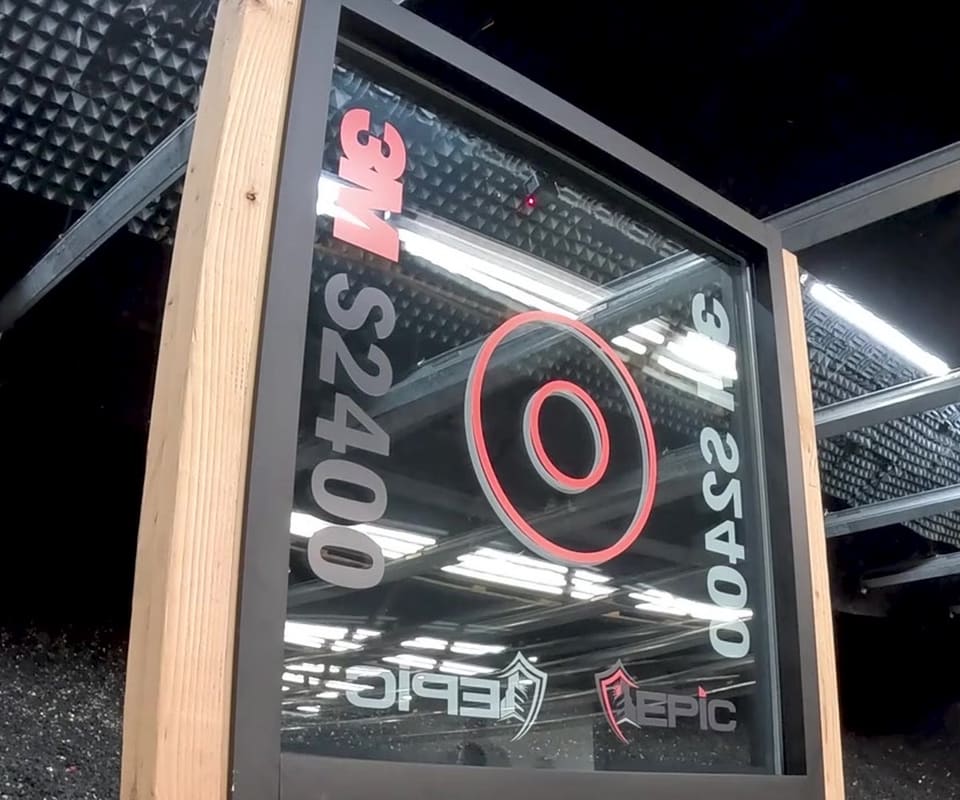
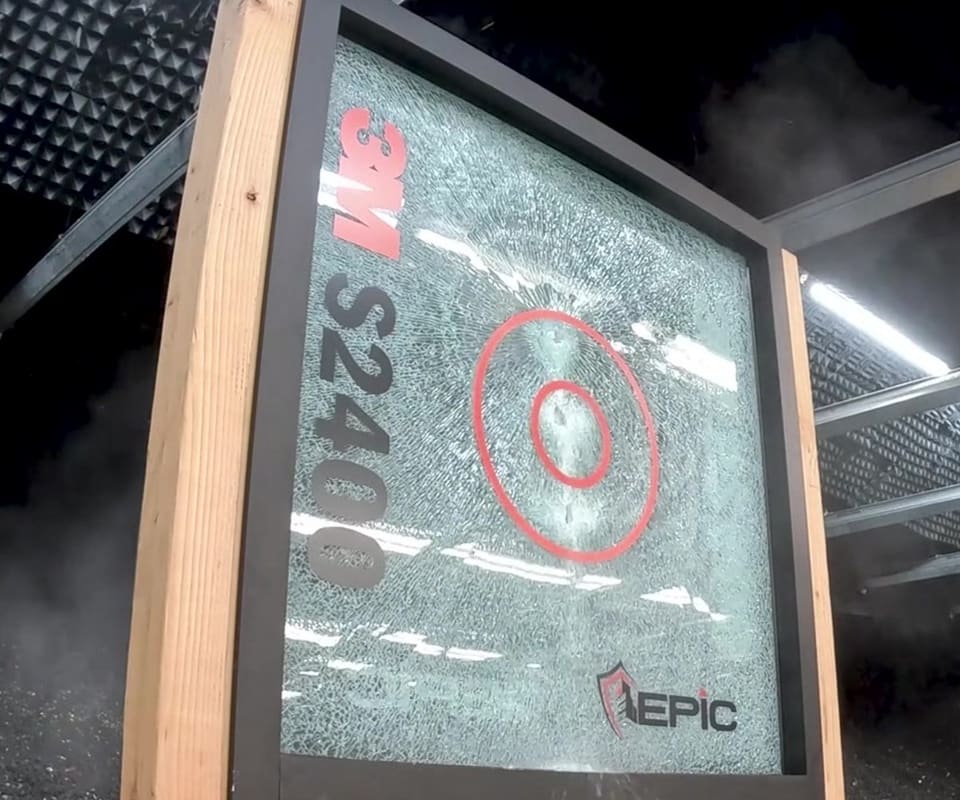
The same panel of glass, before and after Epic’s live demonstration: 3M S2400 attached to the frame with the Epic Method, on a standard quarter-inch tempered double-pane unit. This is the attachment doing its job — the bead keyed into the open channel holding film, glass and frame as one. Drag the handle.
No rendering, no stock photo — two frames, four seconds apart, from one fixed camera at Epic’s demonstration at Royal Range, Nashville. See one in person →
Every Epic Certified Installation Specialist is trained and certified in-house to the Epic Method — our film is never subcontracted. The badge on the shirt is the same one on the van and on this page. How Epic trains and certifies →
Nobody teaches security film as its own trade. So it gets installed like a window treatment.
Window film is an easy business to get into and a hard one to do right. Most installers in this country came up tinting cars and homes, and most of them are good at it. Security film reaches their shop the way every other film does — a roll, a data sheet, a dealer certificate — and it gets treated like every other film. It is not. It is a structural product, and the day it has to work is the worst day a building will have.
The industry has never closed that gap. Manufacturers make the product; they do not teach the trade. Installers learn film, and most have never had a reason to learn how a window is held in the wall — which is exactly where forced entry and blast are decided. Nobody is at fault for what they were never taught. But a building owner is still relying on it.
Here is what most people never see: a window in a home, and on a lot of commercial jobs, is held in by a few screws through the frame and a bead of caulk. That is perfectly good for wind and rain. It is not an answer for a ram or a pressure wave. Film that is bonded only to the glass rides out of that opening with the glass. Film that is anchored to the frame — the 3M IPA attachment, installed the Epic way — makes the glass, the film and the frame one unit, and the opening holds.
Epic knows this because our founder came to window film from the other side of the wall. Chris Eder has practiced construction his whole life — he grew up around the trades, his grandfather was in them, and framing, concrete, dirt work and setting windows in buildings and homes have been constant alongside everything else he has done, including twelve years building one-off custom motorcycles, frames and all, where a structural mistake puts a rider on the pavement. He is a licensed glazier and a window film installer. He does not fit in one box, and the method reflects that: it is a glazier’s answer, a builder’s answer and an installer’s answer at once. The Epic Method, Epic Precision and the apprenticeship exist because someone who has set the window understands what has to happen for it to stay. That understanding is what we train into every Epic Certified Installation Specialist, and it is what we are glad to share with any installer who asks. The industry gets better when the standard does.
How a window is actually held in
| Frame to wall | A few screws through the jamb, shimmed; caulked for weather |
|---|---|
| Glass to frame | A dry gasket (or glazing tape) pressing the glass into the channel |
| Film to glass | Pressure-sensitive adhesive — strong on glass, nothing to the frame |
| What forced entry attacks | The glass-to-frame joint: the pane, film and all, is pushed out of the channel |
| What the Epic Method adds | A structural silicone bond — 3M IPA — from film to frame on three surfaces, with a mechanical interlock |
Film without attachment is a safety-glazing product. Film with the attachment, installed correctly, is a forced-entry system. Same roll.
Film holds glass together. Attachment holds glass in the building.
Every forced-entry event ends at the glass-to-frame bond. Unattached film — even the best 3M film — can be pushed out of the frame as a single sheet. 3M™ Impact Protection Attachment (IPA) — a structural silicone sealant anchoring the film to the frame — converts safety film, glass and frame into one unit, so an intruder has to defeat the film itself rather than pop the pane. Epic installs 3M IPA on every forced-entry job; the Epic Method is how.
No step is optional.
Structural silicone sealant, installed by an Epic-Certified Installation Specialist using Epic’s patent-pending method on existing aluminum-framed glazing — for forced-entry, blast, or windstorm applications.
OEM glazing
The factory-assembled window as it exists today: aluminum frame, interior and exterior EPDM gaskets, insulated glass unit. The starting condition of every retrofit.
Remove interior gasket
The interior (room-side) gasket is removed completely — not trimmed — exposing the channel between glass edge and frame and eliminating the gasket’s oil source. Oil in EPDM rubber is the reason sealant-over-gasket bonds fail.
Cork wedges driven & cut flush
Two cork wedges per side are driven into the open channel, holding the glass tight against the exterior gasket — the glass itself is never moved or reset. Wedge tops are cut flush using the frame edge as a guide — a stable, mechanical seat for bonding.
Security film applied
The specified 3M safety & security film is applied to the room-side surface, bottom edge flush with the frame. Daylight opening fully preserved.
Structural attachment
Structural silicone sealant is tooled into the open channel — 3/8" or 1/2" exposed on both frame and glass/film, with additional sealant keyed into the glazing frame to create a deeper mechanical interlock. Film, glass and frame are now one load-bearing unit.
Minimum bead by application
3/8" satisfies forced-entry and windstorm per the sealant specification. Epic steps up to 1/2" on oversized lites — independent of threat class — for the added glass weight at the bond line.
What sets the Epic process apart
- Structural silicone sealant — the same best-in-class sealant, applied the way its data sheet actually requires.
- Gasket fully removed — deeper structural attachment, no low-surface-energy oil from EPDM.
- Cork wedge system — two cork wedges per side driven into the open channel and cut flush, holding the glass tight against the exterior gasket before bonding.
- Tooled fillet bond — continuous, air-gap-free bead tooled into the open channel.
- Rapid structural cure — tack-free in 60 minutes; full adhesion in 21 days.
- Certified-installer-only — every bead applied by an Epic-Certified Installation Specialist. No exceptions.
The same method, on a real window, by an Epic crew.
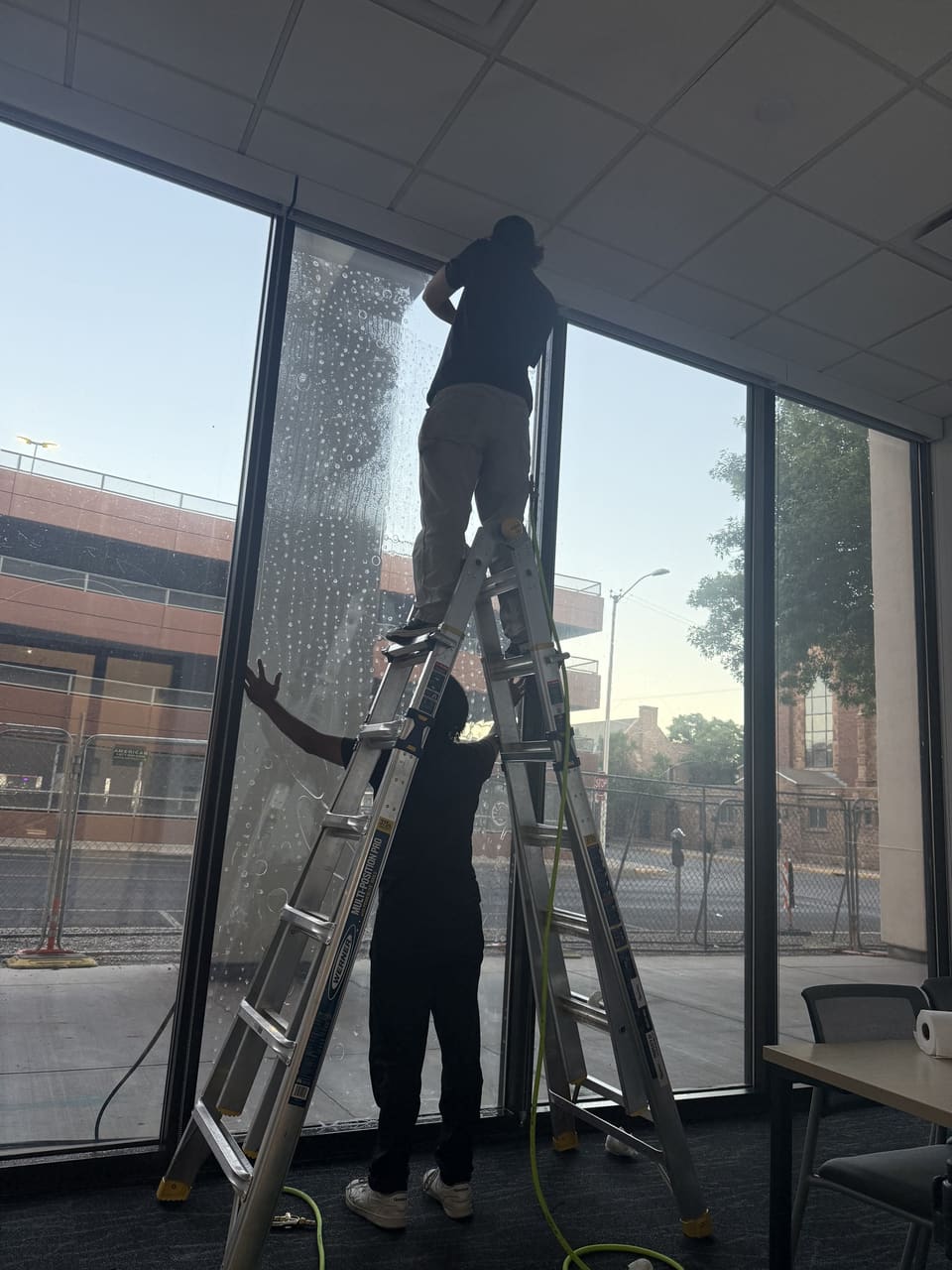
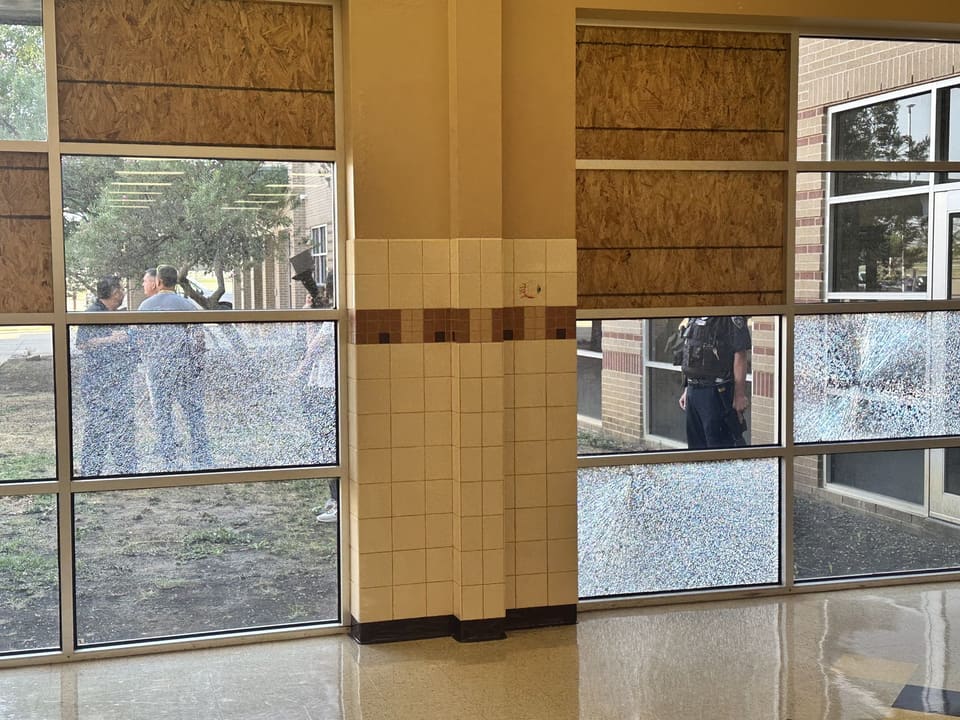
The 3D model shows the anatomy. The film at right shows the whole job on a real school — survey, Epic Precision cutting, kitting, and the attachment going in — by the Certified Installation Specialists who do it every day.
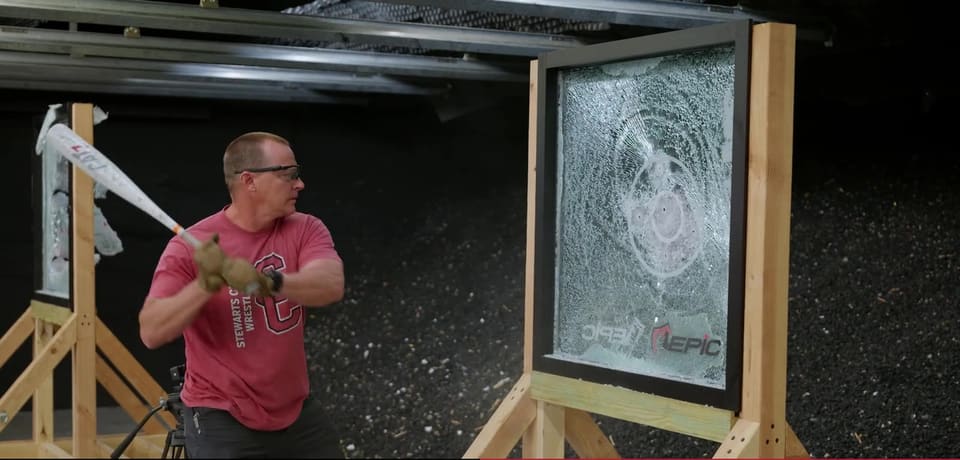
Attached film under forced entry, impact and blast.
3M S2400 demonstrated against forced entry, impact and blast — and the reason Epic will not install security film for forced entry without a structural attachment.
Want it in person? Epic runs live impact demonstrations for districts, consultants and security directors.
The standard was built for a different product than the one it’s being used to judge.
ASTM F3561 is the forced-entry test now showing up in school and government RFPs. It was written for complete OEM window and door systems — not for film applied afterward to glass and frames Epic didn’t design. We tested to it anyway, because a good objection doesn’t win a bid and a specifier deserves data, not the benefit of the doubt.
3M S2400 with the Epic Method on standard commercial aluminum storefront framing, four assemblies in two sizes, Intertek Building & Construction (York, PA; ISO/IEC 17025). Forced-Entry Rating Level 2 achieved on all four assemblies, with the smaller and larger specimens performing the same. That is the tested result for those assemblies — not a compliance claim, not a product rating, and not a bulletproof or forced-entry-proof claim of any kind.
“[ASTM F3561] was not designed to evaluate retrofit building window film that would be applied to a wide variety of existing door/entry and window glass systems.”
“Neither installed window film nor retrofit glazing incorporated into existing framing or doors is covered under ASTM F3561.”
We agree with 3M’s published guidance. The goal isn’t a workaround — it’s a seat at the table while these specifications are still being written, so retrofit film is evaluated on criteria suited to what it actually is.
Not a design patent. A utility patent on the method itself.
Most people hear “patent” and picture a shape — the look of a product. That is a design patent, and it protects almost nothing in a trade like ours. Epic filed for a utility patent. A utility patent protects how something is done: the process, the system, the steps. That is a different animal, and it is the reason this page exists.
Epic’s application covers the installation system you see in the walkthrough above — removing the interior gasket, driving cork wedges into the open channel, carrying the security film to the frame, and keying structural silicone into the open channel so film, glass and frame bond on three surfaces with a mechanical interlock. It is written around the method, not around any one product. It does not matter whose structural sealant is in the gun — 3M™ Impact Protection Attachment (IPA), DOWSIL™ 995, or any other structural silicone a specifier calls out — and it does not matter whose film is on the glass.
In plain terms: Epic has filed a utility patent application on the method — gasket out, structural sealant tooled into the channel. We publish the method because the shortcut fails and children sit behind that glass. Once the patent issues, licensing questions go to [email protected].
Design patent vs. utility patent
| Design | Utility | |
|---|---|---|
| Protects | How a thing looks | How a thing works or is done |
| Covers | One ornamental shape | The method, system and its steps |
| Beaten by | Changing the shape | Not by changing the brand of sealant or film |
| Epic’s filing | — | Utility · patent-pending |
| Applies to | — | 3M IPA · DOWSIL 995 · any structural silicone, any security film |
Patent pending. Epic Solar Control, LLC d/b/a Epic. Questions about licensing the Epic Method: [email protected].
Take the spec with you.
For architects, security consultants, facility directors and procurement. Enter your email and the PDF downloads immediately; we’ll send a copy plus a short series on what to look for in any attached-film specification.
Installed the Epic Way — spec sheet + shortcut comparison
The print-ready 5-page spec: the 5-stage method, minimum bead by application, part numbers, and the shortcut side by side.
How the shortcut is installed — failure-mode handout
One page: the common industry install step by step and where each step goes wrong. It’s not the sealant; it’s the installation.
The Retrofit Gap: ASTM F3561 and retrofit security film
Epic’s position statement with the Intertek test summary — what the standard was written for, what we tested, the Level 2 result on all four assemblies, and exactly what this is not.
Every window has a record — and initials on every step.
Each installer logs every window in Epic’s app and initials each step — cleaning, gasket out, wedges, film, solvent wipe, tape, the structural bead, cleanup. Every building we have worked on is cataloged by room and opening with its measurements and film code, so a repair starts with a photo and a room number, not a re-survey. With your permission, a one-inch Epic tag in the corner tells whoever runs the building next who to call. How the record works →
Expertise. Precision. Innovation. Credibility.
Expertise
Inventor-led · 100% in-house certified crewsPrecision
Epic Precision cutting · the Epic MethodInnovation
Patent-pending method · proprietary softwareCredibility
3M Dealer of the Year, years running · references on fileEpic Method questions
What is 3M IPA, and is the Epic Method the same thing?
Is the Epic Method a special sealant?
Does the Epic Method work with Dow Corning 995 (DOWSIL™ 995) structural silicone?
What does “patent-pending” cover?
What is “the shortcut” and why does it fail?
Does removing the gasket damage the window?
Has the Epic Method been tested?
Does the Epic Method “meet” ASTM F3561?
Is security film bulletproof?
Talk to the people who wrote the method
Specifying attached security film? Send drawings, a glazing schedule, or just the address. Chris Eder’s team will tell you what will and won’t work on your frames.
Four ways in. Pick the one that fits today.
Request a free assessment
On-site survey, film recommendation, written estimate. No obligation.
Request a free energy audit
Every 3M film ranked on your building’s glass, rate and climate — then verified with data loggers.
Download a spec card or guide
Fifteen Epic spec cards, the Epic Method sheet, and the buyer’s guide — free.
Talk to a Solutions Advisor
866.EPIC.117 · Monday–Friday 8–5 Central. A person, not a phone tree.
 Cookies on epiccos.com